



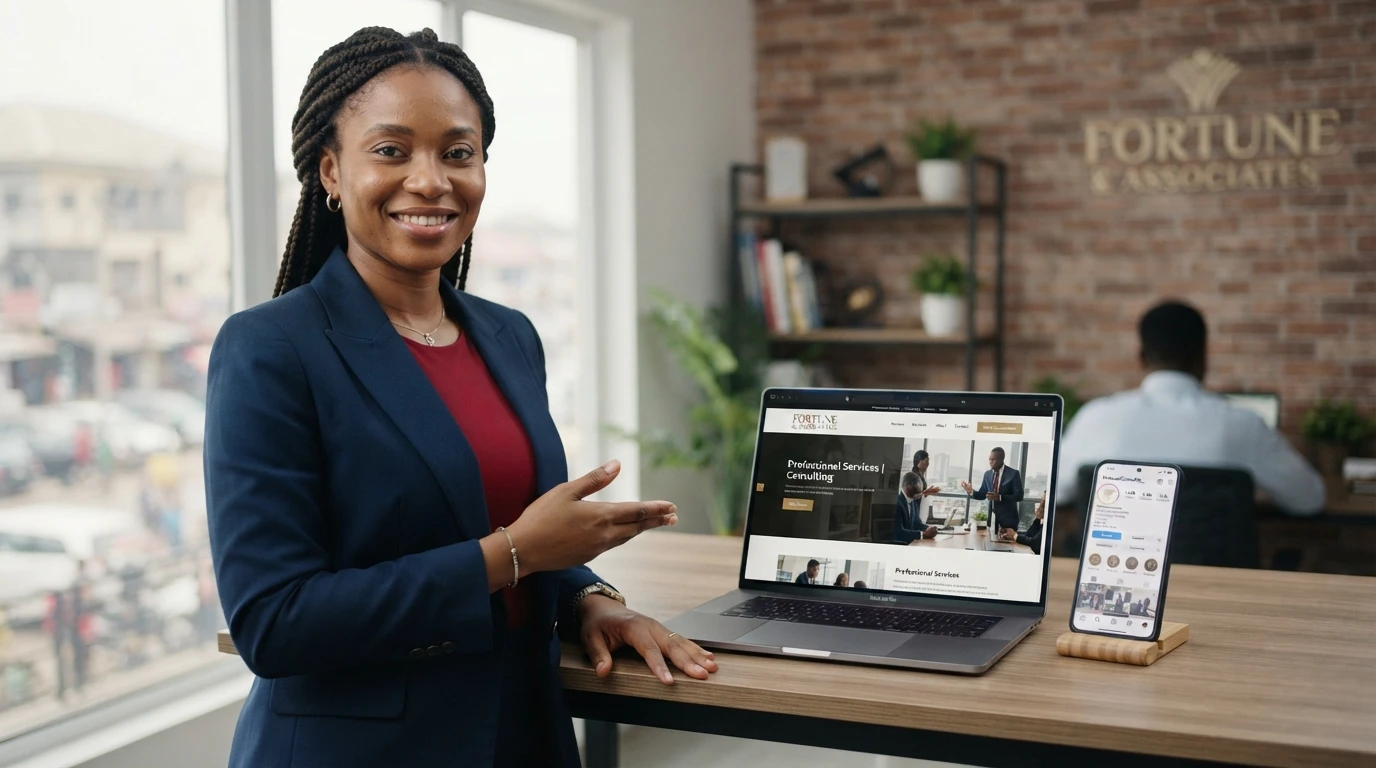
For many small business owners today, Instagram, Facebook, TikTok, and WhatsApp are the first places customers discover their businesses.
And honestly, it makes sense.
Social media is affordable, easy to use, and gives a small business the opportunity to reach thousands of potential customers without spending a fortune on advertising.
But there is one important question every business owner should ask:
What happens if your social media account becomes unavailable, your reach suddenly drops, or the platform changes how it works?
This is where having a professional website becomes more than just a nice addition to your business.
Your social media pages are valuable, but they are rented spaces on platforms you do not control. Your website, on the other hand, is a digital asset that belongs to your business.
And that difference matters.
Social Media Is Important — But It Should Not Be Your Entire Digital Presence
We are not suggesting that businesses abandon Instagram or Facebook.
Far from it.
Social media remains one of the best ways to attract attention, build a community, showcase products, communicate with customers, and promote offers.
The problem starts when a business depends entirely on social media.
Imagine a fashion retailer with thousands of followers on Instagram but no website.
A customer hears about the business and wants to know:
- What products are available?
- How much do they cost?
- Where is the business located?
- Can I order online?
- Is the business legitimate?
- How can I contact them?
- What other services do they offer?
The customer may have to scroll through dozens of social media posts to find the answers.
A well-designed website can bring all of that information together in one professional and organised place.
1. Your Website Is an Asset You Control
One of the biggest advantages of owning a website is control.
Your Instagram page exists because Instagram allows it to exist. Your Facebook business page depends on Facebook. Your TikTok presence depends on TikTok.
These platforms can change their algorithms, policies, features, advertising costs, or visibility rules at any time.
You have little control over those decisions.
Your website is different.
You choose what information appears on it, how customers navigate it, what services you promote, how your brand looks, and what functionality you provide.
Your website can become your business’s digital home base.
Social media can then work as the road that brings people to that home.
2. Algorithms Should Not Decide How Easily Customers Find You
Have you ever posted something you were excited about, only to discover that very few people saw it?
That is one of the challenges of social media.
Your followers do not necessarily see everything you publish.
Social platforms use recommendation and ranking systems to determine what appears in people’s feeds. Those systems change frequently.
A website gives you another channel.
Instead of depending completely on what appears in someone’s social media feed, customers can deliberately search for your business or discover your website through search engines.
For example, someone searching for:
“professional website designer in Nigeria”
could potentially discover a relevant business through Google.
That is a very different kind of visibility from hoping your latest Instagram post reaches the right person.

3. A Professional Website Builds Trust
Think about the businesses you are more likely to trust.
A business with a clear website containing its services, contact information, company story, portfolio, testimonials, FAQs, location, and other useful information often feels more established than one that only has a social media page.
A website does not automatically make a business trustworthy.
But a professional, well-structured website can reinforce credibility.
For SMEs competing with larger businesses, this can be especially important.
Your website gives potential customers another reason to take your business seriously.
4. Your Website Can Explain Your Business Properly
Social media is excellent for short-form content.
But businesses often need more space to explain what they actually do.
A professional website can have dedicated pages for:
Home — A clear introduction to your business.
About Us — Your story, experience, values, and mission.
Services — A detailed explanation of what you offer.
Products — Your products, categories, specifications, and prices where appropriate.
Portfolio — Examples of previous work.
Testimonials — Experiences from previous customers.
Contact — Phone numbers, email, location, social links, and contact forms.
Blog — Helpful information that can attract potential customers through search engines.
Instead of asking customers to piece together your business from scattered social media posts, your website can tell the complete story.
5. Your Website Can Work While You Sleep
Your business does not need to be online at the exact moment a customer becomes interested.
A website can provide information 24/7.
Someone could discover your business at 11:30 p.m., read about your services, look through your portfolio, submit an enquiry, and contact you the following morning.
For service providers especially, this can make a significant difference.
Your website becomes a digital salesperson that is always available to provide basic information and guide potential customers toward the next step.
6. It Makes Your Business Easier to Find on Google
Social media is not the only place people search for businesses.
Many customers use Google when they already have an intention to buy, compare, visit, or contact a business.
For example:
“web designer near me”
“best event decorator in Enugu”
“interior designer in Abuja”
“cake delivery in Nigeria”
“computer repair services near me”
A properly structured website can help your business establish a presence in search results.
With useful content, good technical SEO, accurate business information, and consistent online branding, your website can become a long-term source of organic visibility.
This is particularly valuable because you are building an asset that can continue attracting attention beyond a single social media post.
7. Your Website Can Turn Visitors Into Customers
A website should not simply look beautiful.
It should have a purpose.
A good business website guides visitors toward taking action.
Depending on the business, that action could be:
Call us
Send a WhatsApp message
Request a quotation
Book an appointment
Buy a product
Register for a service
Visit our office
Submit an enquiry
This is why professional web design is about more than colours, images, and animations.
The website needs to understand the customer’s journey.
A visitor should quickly understand:
Who are you?
What do you offer?
Why should I choose you?
How do I get started?
8. Your Website Strengthens Your Brand
Your social media pages may have different layouts, content formats, and platform-specific limitations.
Your website gives you greater control over the overall brand experience.
Your colours, typography, photography, messaging, graphics, service descriptions, and customer journey can all work together.
This creates consistency.
And consistency helps customers remember your business.
For a growing SME, your website can become an important part of your brand identity.
9. You Can Connect Your Website to Your Social Media
Having a website does not mean abandoning social media.
The strongest strategy is often to make them work together.
For example:
Instagram → Website
A customer sees your product on Instagram and visits your website for more information.
Facebook → Website
A customer discovers your business through Facebook and visits your website to request a quotation.
Google → Website
Someone searches for a service and discovers your website.
WhatsApp → Website
A customer receives a link to your website and reviews your services before starting a conversation.
Your website becomes the central destination while your social media platforms help generate attention.
10. Your Digital Strategy Should Not Depend on One Platform
This is perhaps the most important lesson.
Businesses should avoid putting all their digital eggs in one basket.
You can have:
- TikTok
- WhatsApp Business
- Google Business Profile
- A professional website
- A blog
- An online store
Each platform can serve a different purpose.
If one platform changes its algorithm, your entire digital presence should not collapse with it.
A strong digital strategy creates multiple pathways for customers to discover and interact with your business.
But What If My Business Is Small?
This is one of the most common objections.
“My business is still small. Do I really need a website?”
You may not need a massive website with dozens of pages and complicated features.
You need the right website for the stage and needs of your business.
A small service business might only need:
- A professional homepage
- About section
- Services
- Portfolio
- Testimonials
- Contact information
- WhatsApp integration
- Location information
- Enquiry form
An online retailer may need something more advanced, such as:
- Product catalogue
- Shopping cart
- Online payments
- Customer accounts
- Order management
- Delivery information
The goal is not to build the biggest website.
The goal is to build a website that solves the right business problem.
A Website Is Not Just About Looking Professional
There is a difference between having a website and having a useful website.
A poorly designed website can be confusing, slow, difficult to use, or outdated.
A professional website should be:
Fast — Customers should not have to wait unnecessarily for pages to load.
Responsive — It should work properly on phones, tablets, and computers.
Easy to navigate — Visitors should quickly find what they need.
Secure — Basic security and appropriate technical protections should be implemented.
Mobile-friendly — This is particularly important because many customers access the internet primarily through mobile devices.
Conversion-focused — The website should make it easy for visitors to contact or buy from you.
Brand-consistent — The design should reflect the identity of the business.
Your Social Media Page Is a Channel. Your Website Is an Asset.
This is the distinction many growing businesses overlook.
Your social media accounts are channels through which you communicate with customers.
Your website is an asset that you can build, improve, expand, and connect to other parts of your business.
Over time, your website can grow with you.
Today, it may introduce your services.
Tomorrow, it could accept bookings.
Later, it could sell products, manage customer enquiries, publish resources, collect leads, or integrate with your business software.
That is why investing in a website should not be viewed simply as paying someone to “make a website.”
It is an investment in your business infrastructure.
The Bottom Line
Social media can help people discover your business.
Your website can help them understand, trust, and do business with you.
You do not have to choose between the two.
Use social media to attract attention. Use your website to build authority, provide information, capture opportunities, and create a digital home for your brand.
The platforms may change.
Algorithms may change.
Trends may change.
Your business will change too.
But the digital foundation you build today can continue growing with it.
Ready to Build a Stronger Digital Foundation?
At Larnton Smart Solutions, we believe a website should be more than an attractive online page.
It should be built around your business, your customers, and the problem you are trying to solve.
We take time to understand how your business works before designing and developing the right digital solution.
Your business deserves more than a social media page. It deserves a digital home.
Larnton — Turning Ideas into Digital Solutions.
Website: Larnton.com.ng
#Larnton #WebDesign #SmallBusiness #SMEs #DigitalTransformation #BusinessGrowth #WebsiteDevelopment #Entrepreneurship #DigitalBusiness #NigeriaBusiness